Restoration Tips
DIY Water Damage Cleanup: What You Can and Cannot Handle
Some water damage genuinely does not need us. Here is where the line sits, and why "just put a fan on it" fails more often than it works.
The short answer
You can handle a small clean-water spill on hard flooring that you caught immediately. Call a professional for anything that reached carpet, touched a wall, came from a toilet or drain, or that you did not catch straight away. Fans move air but do not remove moisture, so without a dehumidifier you are relocating the problem.
We are a restoration company, so you would expect us to say every water loss needs professional help. It does not, and pretending otherwise is a good way to lose someone's trust the first time they realize it.
Here is where the line actually sits.
You can handle this yourself
- A small clean-water spill on hard flooring — tile, sealed concrete, luxury vinyl plank — that you caught immediately. Mop it, dry it, run a fan, check under the edges of anything adjacent.
- An overflowing sink or tub caught within minutes, where water stayed on the hard surface and did not reach carpet, cabinets, or a wall base.
- A dishwasher that leaked a small amount onto tile and was caught before it ran under the cabinet. Check the cabinet toe kick carefully — that is where it hides.
- Condensation on a window or around a toilet base, which is a ventilation or seal problem rather than a water loss.
- A minor roof drip into a bucket during a storm, provided you get the roof addressed before the next one and check the attic for wet insulation.
The common thread: clean water, hard surfaces, caught immediately, no chance it reached an enclosed space.
Call somebody for this
- Anything that reached carpet. The pad holds several times its weight in water and cannot be dried in place with household equipment. This is the single most common DIY failure.
- Anything that touched a wall. Drywall wicks water upward. The bottom of that cavity is wet whether or not the surface looks it.
- Anything from a toilet, drain, or outdoors. Category 3 water is a health matter, not a cleanup matter.
- Anything you did not catch immediately. If you do not know how long it ran, assume long enough to matter.
- Anything involving a ceiling. Water above your head has been through insulation and past electrical, and a saturated ceiling is a genuine safety issue.
- Anything from a slab leak. Water coming up through the floor means it has been under there for a while, and concrete does not dry with a box fan.
The thing fans cannot do
This is worth understanding properly, because it is the misconception that turns small losses into large ones.
A fan moves air across a wet surface. That accelerates evaporation, so the water leaves the carpet — and enters the air in your house as water vapour. It has not left the building. It has changed form and relocated.
Without a dehumidifier removing that vapour, it condenses somewhere cooler: inside a wall cavity, on the underside of a countertop, in a closet, against a window. You have effectively run a humidifier in your house for three days. That is why "I dried it with fans" and "there was mold behind the wall a month later" go together so often.
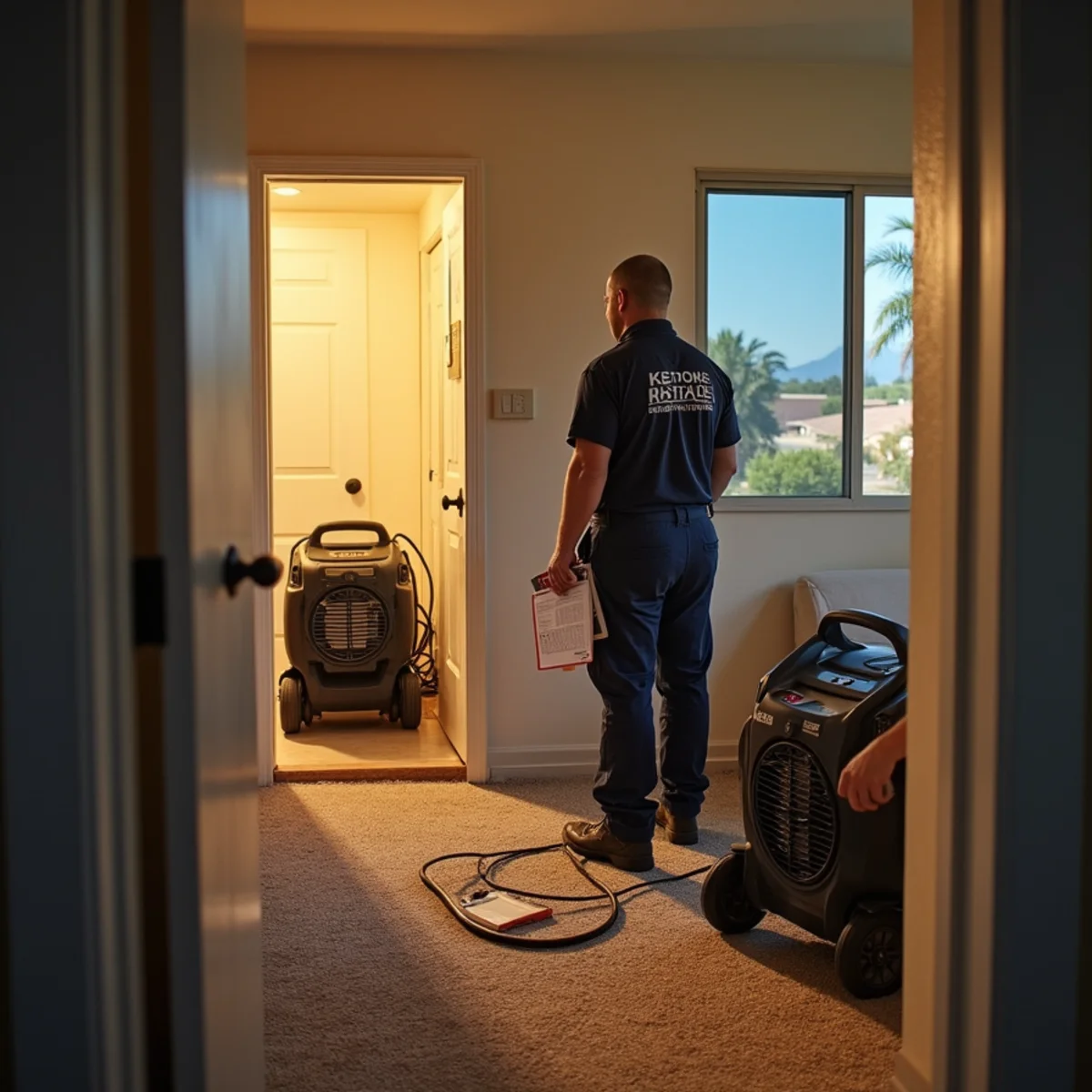
The professional version pairs air movers with low-grain refrigerant dehumidifiers sized to the space, so the moisture actually leaves the building through a drain line. That is the whole point of structural drying and dehumidification, and it is not something a consumer dehumidifier from a big-box store can do at the required capacity.
What renting equipment actually gets you
You can rent air movers and a dehumidifier. For a small clean-water loss on a hard floor, that is a reasonable move.
What you cannot rent is the ability to know when you are done. Professional drying works against a dry standard — a moisture reading taken from unaffected material of the same type elsewhere in your house. Every affected material gets metered daily against that target. Without meters, you are guessing about the inside of a wall based on how the outside feels, and that guess is wrong more often than not.
The honest cost comparison
For a genuinely small clean-water spill, DIY costs you an afternoon and maybe a rental fee. That is the right call and we will tell you so on the phone.
For anything that reached carpet, a wall, or a cavity, the comparison is different. A professional dry-out on a modest loss might run a few thousand dollars, usually paid by your carrier minus the deductible. The failed-DIY version arrives a month later as mold remediation plus demolition plus rebuild — and mold from a leak you did not properly address is exactly the kind of claim carriers decline as gradual damage.
What to do if you are unsure
Call and describe it. We inspect free, and a fair share of those inspections end with us telling someone their situation genuinely does not need us. Getting a moisture reading before you decide costs nothing and removes the guesswork entirely.
And if you are in a 1990s home in Menifee Lakes or anywhere with original copper, ask us to check the rest of the plumbing while we are there. Most of the large jobs we work started as something small that someone reasonably decided to handle themselves.
What a rented dehumidifier actually removes
This is the number that settles most DIY arguments, and it is rarely stated plainly. Dehumidifiers are rated in pints of water removed per day, and the gap between what you can rent or buy and what a restoration crew brings is not a small percentage — it is a different order of machine.
A consumer dehumidifier from a home improvement store is typically rated somewhere in the region of thirty to fifty pints per day, and critically that rating is measured in warm, already-humid conditions. As the room dries and the humidity drops, its extraction rate falls off sharply — exactly when you need it most. A commercial low-grain refrigerant unit is built to keep pulling water at low humidity, which is the entire point of the design.
Then there is the air movement side. Evaporation is what a dehumidifier is removing; without directed airflow across wet surfaces at the right angle, the water stays in the material and the machine has nothing to collect. A box fan pointed at a wet carpet moves room air around. It does not create the boundary-layer airflow that lifts moisture out of the material underneath.
The insurance consequence of drying it yourself
This is the part that costs people money later, and almost nobody thinks about it on day one. Policies require you to mitigate — to take reasonable steps to prevent further damage. Attempting the drying yourself does satisfy that in principle. What it does not produce is evidence.
If the job goes well, nothing comes of it. If it does not — if mould appears in the wall cavity four months later, or the flooring cups because the subfloor never actually reached standard — you are making a claim about a loss with no moisture readings, no daily logs and no photographic record of what was wet and when. Carriers are entitled to ask when the damage occurred and whether it was properly mitigated, and without documentation the honest answer is that nobody knows.
That is not an argument for calling a company every time something spills. It is an argument for being clear-eyed about which side of the line your particular job is on, and for photographing and metering it yourself if you do decide to handle it.
Frequently asked questions
Can I rent a dehumidifier and do this myself?
For a small clean-water spill on hard flooring, yes. For anything that reached carpet, a wall, or an enclosed cavity, rental equipment gets you airflow but not the moisture meters that tell you when the structure is genuinely dry — and that is the part that matters.
How do I know if water got into the wall?
You generally cannot tell by looking. A cool, slightly swollen baseboard is a strong hint, and a musty smell that returns when the house is closed up is another. A moisture meter settles it in about thirty seconds, which is why we inspect free.
Is it worth filing a claim on a small loss?
If the cost is well under your deductible, probably not. If water reached a wall cavity or subfloor, file — because if it turns into mold later and you did not document the original event, the mold claim gets denied as gradual damage.
If I dry it myself and it fails later, will insurance still cover it?
Possibly, but you will have a much harder claim. The carrier is entitled to establish when the damage happened and whether it was mitigated properly, and without moisture readings or dated photographs there is no record either way. If you do handle it yourself, photograph everything at the start, note the date, and keep a simple daily record of what you did — it costs nothing and it is the difference between a documented loss and an assertion.
Are the moisture meters sold at hardware stores any good?
The inexpensive pin-type meters are genuinely useful for one thing: comparing a suspect area against a known-dry area of the same material in the same house. That relative reading will tell you whether something is still wet. What they are not reliable for is an absolute number you can act on, and they will not read through tile, into a wall cavity or into a slab. For a small clean-water job, a cheap meter used comparatively is much better than guessing.