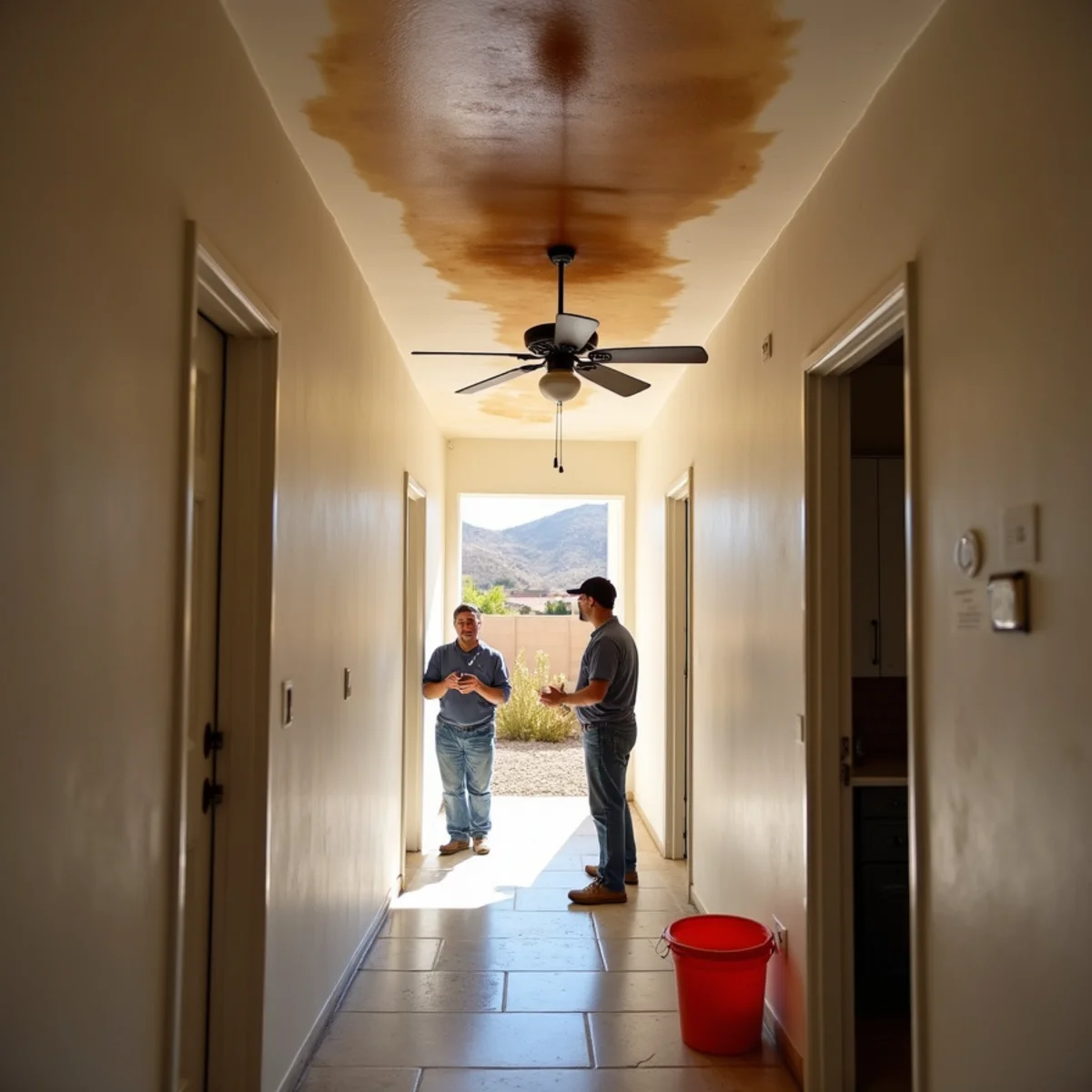
Ceiling water damage repair in Menifee means finding the source above the stain first, then drying the cavity and matching the texture on the repair. In this city the cause is usually one of three things: a clogged air conditioner condensate line, a wind-lifted roof, or upstairs plumbing in a two-storey tract home. Painting over the stain fixes none of them.
Painting over it does nothing. The stain will come back, the drywall will keep absorbing, and eventually a saturated sheet will let go. Wet drywall is heavy, and a ceiling that comes down takes light fixtures with it.
We find the actual source, dry the cavity and the insulation above it, and repair the ceiling so the patch does not read as a patch.
Reading a ceiling stain
The shape and behavior of the stain tell you a lot before anyone goes into the attic.
A ring that is getting bigger
A defined brown ring with a growing edge means water is still arriving. A stain that has not changed in a year is old damage from a leak that already stopped.
Sagging, bulging, or a soft spot
This is the urgent one. The drywall is holding standing water. Keep people out of the room and call — do not poke it while standing underneath.
A stain directly under an upstairs bathroom or laundry
In Menifee's two-story tracts, that geometry almost always means a supply line, drain, or wax ring on the floor above.
A stain near a return vent or in a hallway ceiling
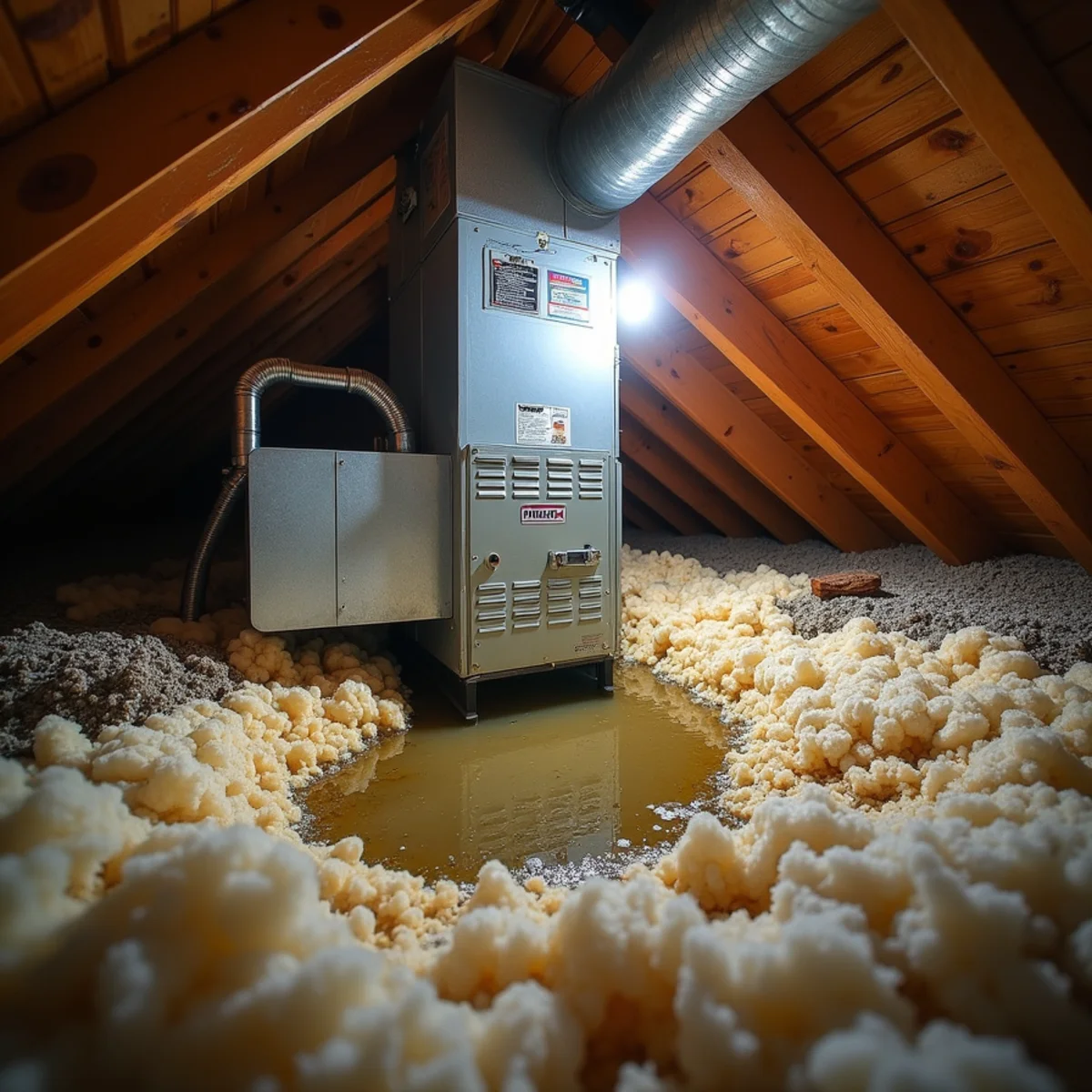
The classic AC condensate signature. Air handlers in Menifee attics drain through a condensate line, and when it clogs the pan overflows straight onto the ceiling below.
Blistering paint or a hairline crack that has opened
Moisture behind the paint film lifts it. A crack that widened over a season is drywall that has been wet, dried, and moved.
What a ceiling repair job includes
The visible stain is the smallest part of the work. Everything below is in the same scope.
Making the room safe
If the ceiling is sagging we relieve the trapped water in a controlled way and cut power to any fixture in the affected plane before anything else. A saturated sheet can release many gallons and a light fitting at once.Source diagnosis, not guesswork
Attic inspection, thermal imaging and where needed a water test. In summer we check the condensate line and drain pan first; after a wind event, the roof and flashing; in a two-storey home, the plumbing directly above.Insulation removal and cavity drying
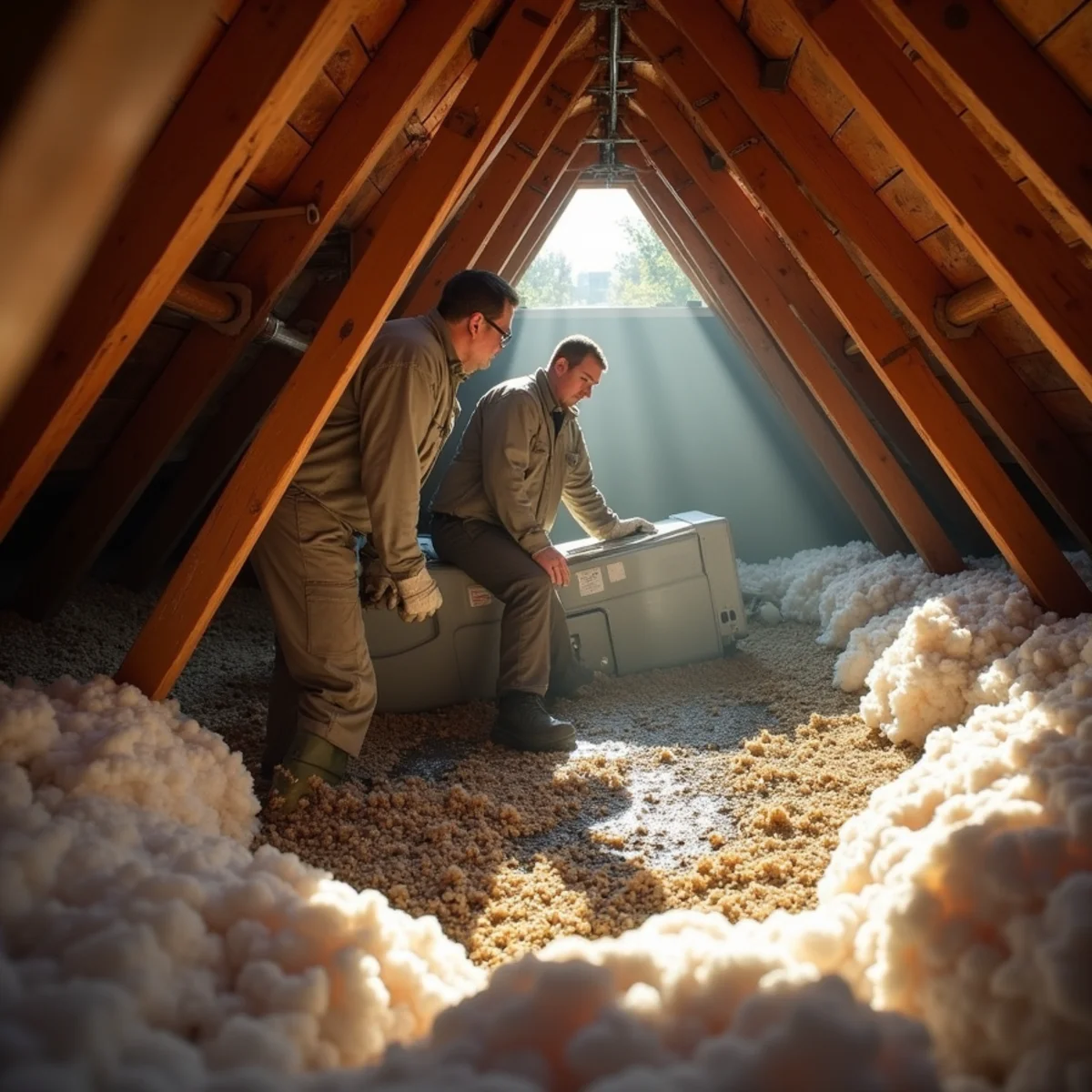
Saturated blown-in insulation compacts and never regains its R-value, so it comes out. The ceiling assembly and attic space are then dried with daily metered readings before anything is closed up.Texture-matched rebuild
New drywall, then texture matched to the surrounding ceiling — knockdown, orange peel or the light spray common in Menifee tracts — and paint carried to a natural break so there is no visible seam.
The AC condensate problem nobody warns you about
Menifee summers put air conditioners under sustained load for months. Every one of those hours, the evaporator coil pulls humidity out of the air and drains it away through a small condensate line. That line runs at a slight slope, it is usually PVC, and it clogs — with dust, with biological slime, and in this water with mineral scale.
When it clogs, water backs up into the drain pan. If the secondary pan and float switch are working, the system shuts down and you get a warm house. If they are not — and in a lot of 1990s installations they are not — the pan overflows into the attic insulation and onto the ceiling drywall below. That is why a huge share of the ceiling damage we repair in this city has nothing to do with rain.
The Santa Ana angle compounds it. Wind events drive fine dust into attics and across coils, which is exactly what feeds the clog. A ceiling stain that appears in August, in a house with no roof damage, is a condensate line until proven otherwise.
The rest divides between roof breaches after wind events and second-floor plumbing in the two-story tracts of Menifee Lakes, Paloma Valley, and Audie Murphy Ranch.
How we repair a water-damaged ceiling
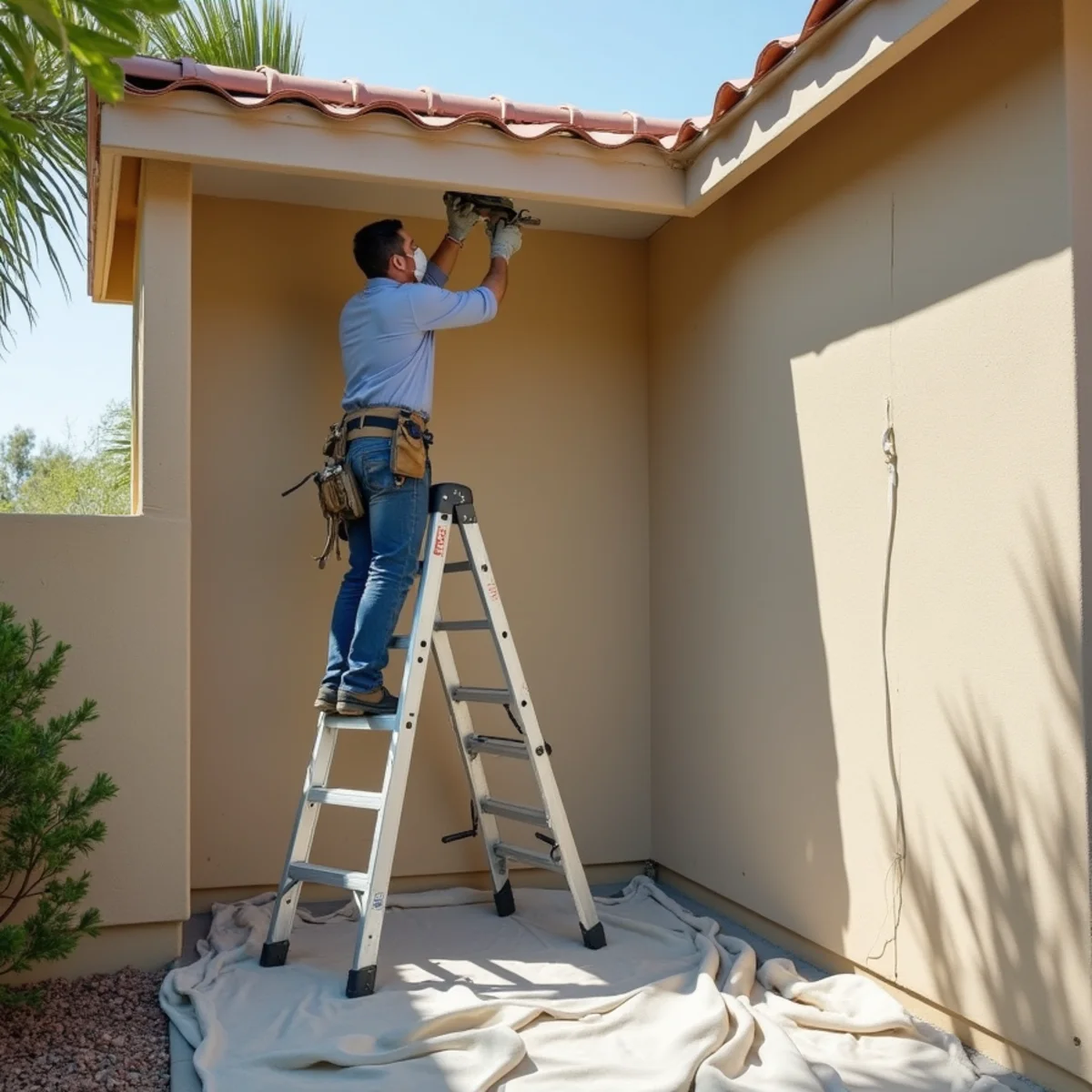
Source first. Repairing a ceiling without finding what wet it just buys you a second repair.
- 1
1. Make the room safe
If the ceiling is sagging, we relieve the trapped water in a controlled way and shut power to fixtures in the affected area before anything else happens.
- 2
2. Find the source
Attic inspection, thermal imaging, and where needed a water test. We check the condensate line and pan first in summer, the roof and flashing after a wind event, and the plumbing above in two-story homes.
- 3
3. Stop the leak
Clear the condensate line, tarp the roof breach, or shut and repair the plumbing. Drying cannot start while water is still arriving.
- 4
4. Remove what will not recover
Saturated drywall and soaked blown-in insulation come out. Wet insulation compacts and never regains R-value — leaving it in costs you on every summer utility bill afterward.
- 5
5. Dry the cavity and framing
Airflow and dehumidification in the attic and ceiling assembly, metered daily, until framing and remaining materials are back to the dry standard.
- 6
6. Rebuild and texture match
New drywall, then texture matched to the surrounding ceiling — knockdown, orange peel, or the light spray common in Menifee tracts — then primer and paint across the full plane so there is no visible seam.
What ceiling water damage repair costs
Ceilings are more labor than material. What drives cost is height, texture, and how much insulation has to come out.
Area affected
A two-foot patch in a hallway is a small job. A great-room ceiling with a vaulted plane needs scaffolding and full-plane repainting to avoid a visible repair.
Texture type
Flat and orange peel match easily. Heavy knockdown and older hand textures take skill to blend, and that time shows up in the estimate.
Insulation replacement
Removing and replacing saturated blown-in insulation across the affected attic bay is routine and frequently unexpected.
What caused it
Clearing a condensate line is inexpensive. Roof repair or opening a second-floor wall to reach a leaking drain is a separate and larger scope.
Why call us for a ceiling stain
Most ceiling repairs fail because somebody fixed the drywall and not the reason it got wet.
We check the condensate line first in summer
A ceiling stain appearing in August in a house with an intact roof is an air conditioner condensate line until proven otherwise. It is the most common non-storm ceiling failure in Menifee and the one most often misdiagnosed as a roof leak.
Texture matching is in the scope, not an upsell
Menifee tracts use a handful of standard ceiling textures and we work in all of them. On a small plane we usually repaint corner to corner, because even a perfect texture match shows if the paint is a different age.
We look at the electrical the water crossed
Water travels along framing and reaches fixture boxes. Assessing that is part of a ceiling job, not an afterthought once the drywall is back up.
Insulation restored to spec
Wet insulation left in place costs you on every summer utility bill afterwards. We remove it, replace it to the correct depth, and note it on the scope so the carrier pays for it.
Frequently asked questions
My ceiling is bulging. What do I do right now?
Get everyone out of the room and put a bucket under it. If you can safely reach the breaker, kill power to any light or fan in that ceiling. Do not stand underneath and puncture it — a saturated sheet can release many gallons and a fixture at once. Call us and we will relieve it safely.
Can I just paint over the stain?
Only once the source is fixed and the drywall is verified dry, and even then you need a stain-blocking primer or the tannins bleed straight back through. If the ceiling is still wet, paint traps moisture against it and makes the eventual repair bigger.
Why does my ceiling leak in summer when it has not rained?
Almost always the AC condensate line. It clogs, the drain pan overflows, and water goes through the attic into the ceiling. It is one of the most common ceiling failures in Menifee and one of the easiest to prevent — see AC condensate drain line maintenance.
Will you match my ceiling texture?
Yes. We work in the textures used across Menifee tracts and blend into the surrounding surface rather than dropping in a flat patch. On a small plane we usually repaint corner to corner, because even a perfect texture match will show if the paint is a different age.
How do I know whether it is the roof or the air conditioner?
Season and geometry. A stain that appears in summer with no rain, near a return vent or in a hallway ceiling, is almost always the AC condensate line overflowing into the attic. A stain that appears during or shortly after rain, and is worse when the wind blows from one direction, points to the roof. A stain directly beneath an upstairs bathroom or laundry is plumbing. We confirm it in the attic rather than guessing from below.
Where we provide ceiling water damage repair in Menifee
We run this service across every Menifee neighborhood and out into the surrounding cities. Response times are honest drive-time bands from our shop on Palomar Road, not marketing numbers.
- Ceiling Water Damage Repair in Menifee, CA
- Ceiling Water Damage Repair in Menifee Lakes
- Ceiling Water Damage Repair in Audie Murphy Ranch
- Ceiling Water Damage Repair in Heritage Lake
- Ceiling Water Damage Repair in Quail Valley
- Ceiling Water Damage Repair in Sun City, Menifee
- Ceiling Water Damage Repair in Paloma Valley
- Ceiling Water Damage Repair in Canyon Hills
- Ceiling Water Damage Repair in Romoland
- Ceiling Water Damage Repair in Homeland
- Ceiling Water Damage Repair in McCall Boulevard
- Ceiling Water Damage Repair in Newport Road