
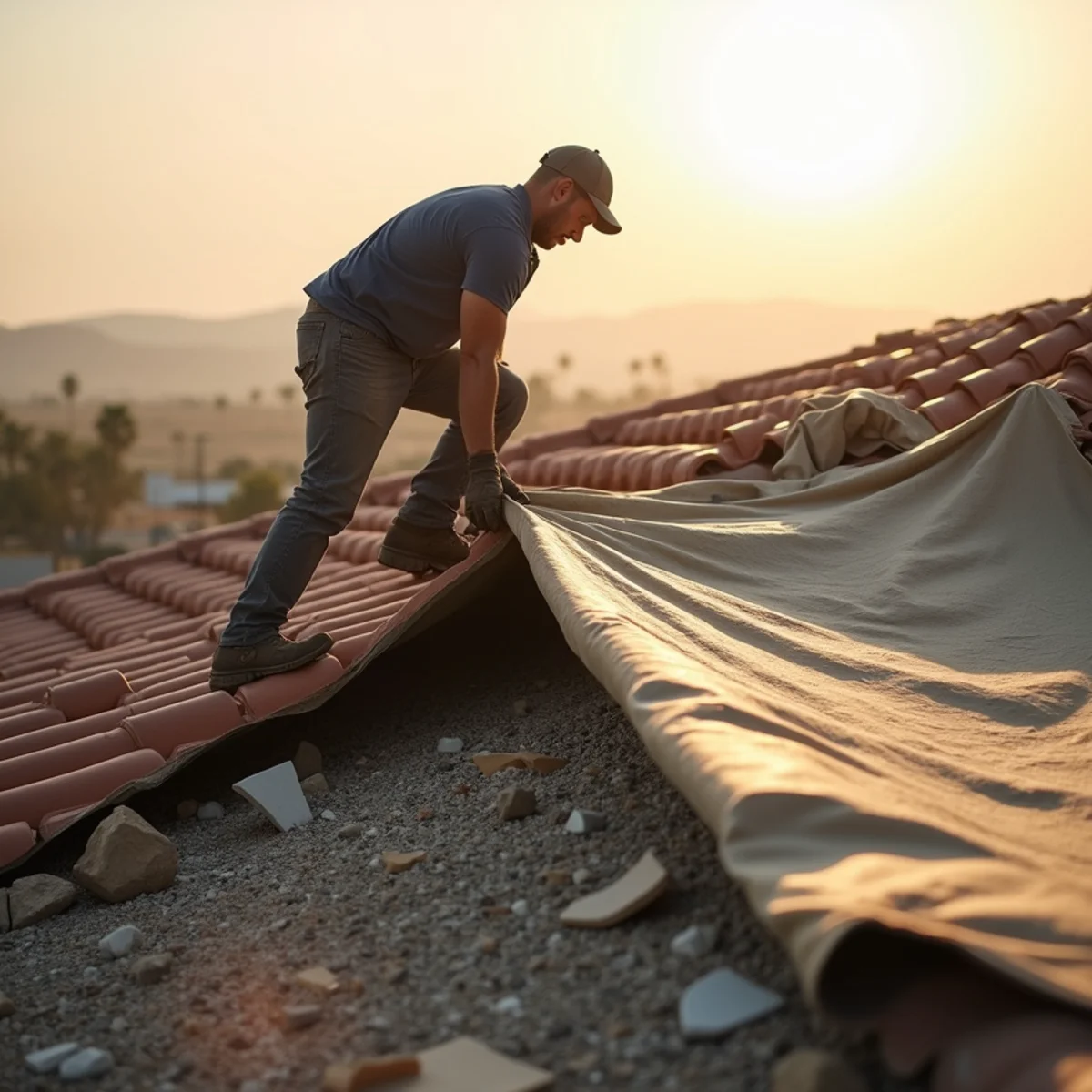
Storm damage restoration in Menifee starts with stopping the loss — tarping the roof or boarding the opening the same night — then handles the water that got in and the repair that follows. Most storm damage here is a wind story before it is a rain story: Santa Ana gusts lift tile between September and April, and the next storm finds the opening.
The first job is stopping the loss: tarp the roof, board the opening, get water out of the structure. The second is the repair. We do both, which means you are not chasing a roofer, a restoration company, and a drywall contractor while your ceiling is open.
We keep tarp and board-up materials on the truck through Santa Ana season. When the wind lays down at 2 a.m., we can be on the roof at first light.
After the wind stops, check these
Most storm-related water damage starts with something that happened on the roof hours or days earlier. A ten-minute look can save a ceiling.
Tile pieces or granules in the yard
Broken tile fragments on the ground mean a course lifted. Loose granules pooling at a downspout mean asphalt shingle is shedding its wear layer and no longer sheds water reliably.
A new stain on a ceiling or in a corner
Even a small ring after a wind event usually means the underlayment has been breached. It will not improve on its own, and the next storm will make it obvious.
Lifted or missing ridge cap
Ridge and hip lines take the highest uplift. Once the cap goes, wind-driven rain enters directly at the peak and travels the length of the attic.
Grit inside window tracks
Santa Ana events carry dust that packs into weep holes and seals. Blocked weeps mean the next rain backs up in the frame instead of draining out of it.
A limb resting on the roof
Even a branch that did not puncture anything abrades the surface every time the wind moves it. Get it off before the next event, and check what is underneath it.
What storm damage restoration covers
Two phases under one contract: emergency mitigation tonight, permanent repair once daylight shows the full picture.
Emergency tarping and board-up
A properly fastened tarp over the breach and board-up on any broken opening — not a sheet weighed down with bricks. This is what your policy expects you to do to prevent further damage, and it is what stops a roof repair becoming a roof plus a ceiling plus a room of flooring.Attic assessment and insulation removal
We trace the water from the entry point along the framing to wherever it reached the ceiling, which is often a surprising distance, and check any electrical it crossed. Saturated blown-in insulation comes out — it never regains its R-value.Documented damage record for the claim
Photographs from the roof, the attic and the interior, plus moisture readings. Wind claims turn on whether the carrier calls it storm damage or wear, and adjusters do not climb every roof.Roof repair and interior restoration
Underlayment, flashing, tile or shingle and ridge cap restored to match, then ceiling drywall, texture, paint and any flooring the water reached. We work in the tile profiles and shingle lines used across Menifee tracts so repairs blend.
The Menifee storm calendar
Santa Ana season runs roughly September through April. Offshore pressure gradients push dry air down through the passes and out across the valley, gusting 40 to 60 mph and occasionally higher. It is not the sustained speed that does the damage so much as the uplift at roof edges, ridges, and eaves — the exact places tile and shingle are most vulnerable.
Monsoon season, July through September, brings the opposite: little wind, intense localized rain, and occasional hail. Those cells find whatever the Santa Anas loosened. Then winter Pacific storms arrive December through March with steady multi-day rain that tests every seal and every yard drain in the city.
There is a compounding factor here that a lot of homeowners miss. Menifee roofs bake under heavy UV all summer and swing 40 to 50 degrees between afternoon and night. That thermal cycling embrittles underlayment, opens nail holes, and cracks sealant, so by the time the wind arrives the roof is already tired. A lot of the "storm damage" we tarp is really a 25-year-old roof meeting a routine wind event.
From emergency tarp to finished repair
Two phases, one crew. Emergency work happens tonight; the permanent repair happens once we can see the whole picture in daylight.
- 1
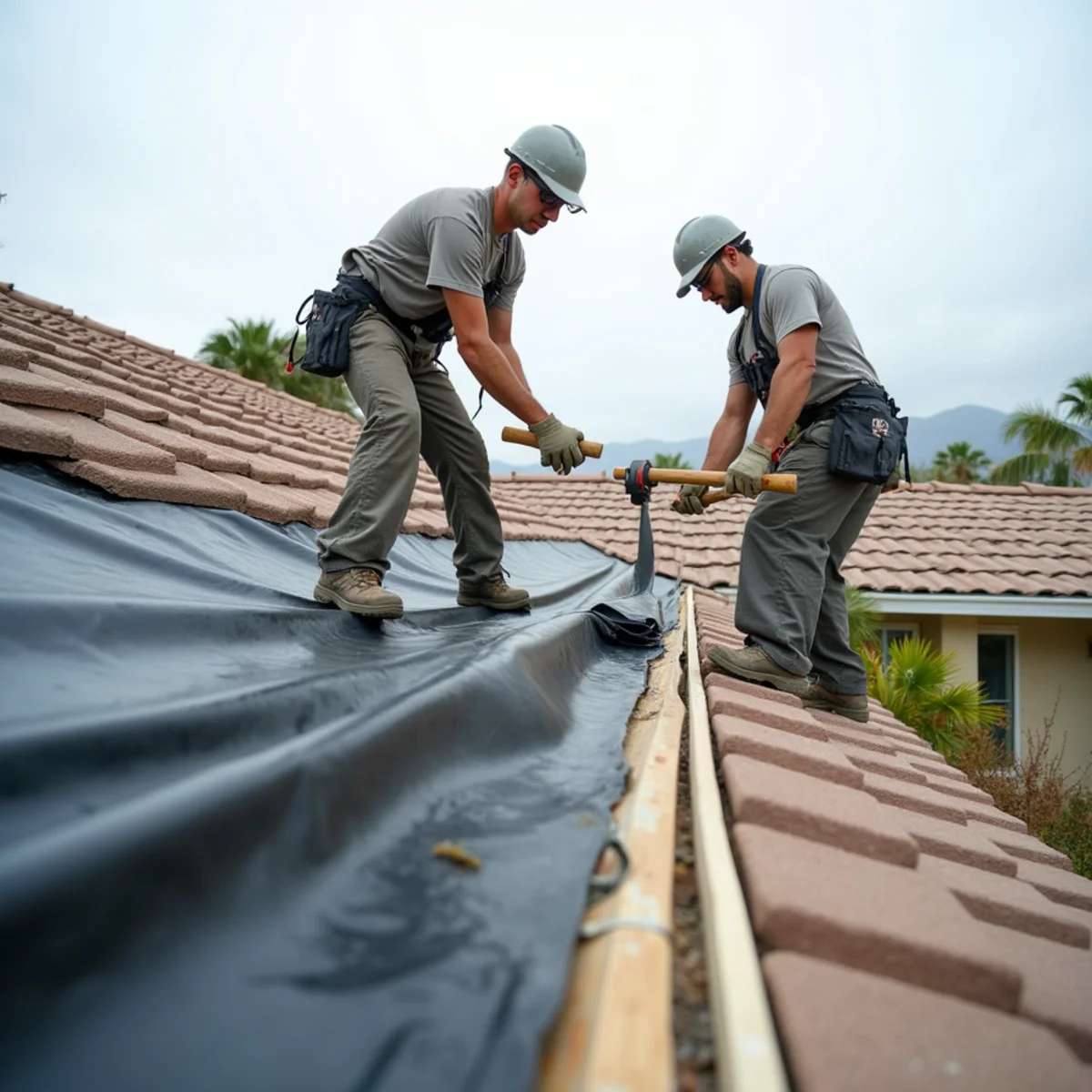
1. Emergency tarp and board-up
We stop water entry first — roof tarps, window board-up, and shrink-wrap on exposed openings. This is what insurers expect you to do immediately, and it protects your claim.
- 2
2. Water extraction and attic assessment
Water that entered at the roof is in the insulation and often across the ceiling drywall. We extract, pull saturated insulation, and evaluate whether the ceiling assembly is safe.
- 3
3. Damage documentation
Photos from the roof, the attic, and the interior, plus moisture readings. Wind claims turn on documentation, and adjusters do not climb every roof.
- 4
4. Structural drying
Attic and ceiling cavities are dried and metered daily. Wet blown-in insulation loses R-value permanently, so we determine what recovers and what gets replaced.
- 5
5. Roof and envelope repair
Tile, shingle, underlayment, flashing, and ridge cap restored to match. We work in the tile profiles and shingle lines used across Menifee tracts so repairs blend.
- 6
6. Interior restoration
Ceiling drywall, texture, paint, insulation, and any flooring the water reached — finished so you cannot tell where the repair starts.
What storm damage restoration costs
Storm jobs vary more than any other loss type because the damage above the ceiling and the damage below it are effectively two different projects.
Emergency mitigation
Tarping and board-up are billed by area and access. It is the smallest line on the estimate and the one that most reduces the total, because it stops the loss from growing.
Roof repair scope
Replacing a dozen tiles is one number. Replacing underlayment across a slope is another. Concrete tile, clay tile, and architectural shingle all carry different material costs.
How far the water traveled
Water entering at a ridge can run the length of an attic before it appears at a ceiling, which is why the interior scope is often larger than the roof scope.
Insulation replacement
Saturated blown-in insulation compacts and does not recover its R-value. Removing and replacing it across an affected attic area is a routine line item people do not expect.
Why call us after a Santa Ana event
The gap most homeowners fall into is hiring a roofer and a restoration company separately, then discovering neither owns the middle.
We carry tarp and board-up materials through wind season
September through April we keep them on the truck specifically for this. When the wind lays down at 2 a.m. we can be on the roof at first light rather than ordering materials.
Roof and interior under one scope
We tarp, repair the roof, dry the attic and finish the ceiling as one job. A split scope between a roofer and a restoration company is exactly where coverage gaps appear on a wind claim.
We know what this climate does to a roof
Menifee roofs bake under summer UV and swing 40 to 50 degrees between afternoon and night, which embrittles underlayment long before the wind arrives. A lot of what gets called storm damage is a tired roof meeting a routine gust — we will tell you honestly which one you have.
Documentation that survives an adjuster
Dated photographs of fresh breaks, lifted courses and debris in the yard, taken before any repair. That record is what distinguishes a covered wind claim from a denied maintenance claim.
Frequently asked questions
Can you tarp my roof tonight?
Usually yes. We carry tarp and board-up materials through Santa Ana season specifically for this. If wind is still gusting hard enough to make the roof unsafe, we secure the interior, set containment under the leak, and go up as soon as it lays down.
Is wind damage covered?
Wind is a covered peril on essentially every standard homeowners policy. The dispute is usually over cause: carriers look hard at whether an aging roof failed on its own. Photographs taken before any repair, showing lifted courses and fresh breaks, are what settle that argument.
A branch is on my roof. Do you remove trees?
We coordinate tree removal with local crews rather than doing it ourselves, and we handle everything from the roof deck in. That way the tarp goes on the moment the limb comes off instead of waiting for a second appointment.
My ceiling is sagging after the storm. Is that urgent?
Yes. A sagging, bulging, or dripping ceiling is holding water and can come down in a sheet. Keep everyone out of that room, and if it is safe to reach the breaker, kill power to any fixture in the affected area. Call immediately — see ceiling water damage repair.
The storm was weeks ago and my ceiling only just stained. Is it still a claim?
Often yes, and this is common here. Wind lifts roofing in the autumn, the underlayment is exposed but nothing leaks until the first real rain, which can be months later. What matters is documenting the wind event as the cause — photographs of broken tile, lifted courses or debris, plus an attic inspection showing the entry point. Report it as soon as you see the stain rather than waiting to see whether it spreads.
Where we provide storm damage restoration in Menifee
We run this service across every Menifee neighborhood and out into the surrounding cities. Response times are honest drive-time bands from our shop on Palomar Road, not marketing numbers.
- Storm Damage Restoration in Menifee, CA
- Storm Damage Restoration in Menifee Lakes
- Storm Damage Restoration in Audie Murphy Ranch
- Storm Damage Restoration in Heritage Lake
- Storm Damage Restoration in Quail Valley
- Storm Damage Restoration in Sun City, Menifee
- Storm Damage Restoration in Paloma Valley
- Storm Damage Restoration in Canyon Hills
- Storm Damage Restoration in Romoland
- Storm Damage Restoration in Homeland
- Storm Damage Restoration in McCall Boulevard
- Storm Damage Restoration in Newport Road