Local Menifee Risks
How Menifee's Hard Water Is Quietly Destroying Your Plumbing
Your water district operates reverse-osmosis desalination plants because the groundwater here is brackish. That fact explains most of the plumbing failures in this city.
The short answer
Eastern Municipal Water District draws from a brackish groundwater basin and runs reverse-osmosis desalination plants to treat it. The treated water is safe but still mineral-rich, which puts sediment in water heaters, scale at every valve seat, and accelerates the pitting corrosion that turns 25-to-40-year-old copper into a pinhole leak.
Here is a fact most Menifee homeowners do not know: Eastern Municipal Water District operates dedicated desalination facilities to treat your drinking water. Not because of contamination — because the local groundwater is naturally brackish, mineral-rich enough that it needs reverse osmosis to be palatable.
The Menifee Desalter has been running since 2002, producing around three million gallons a day. The Perris I desalter followed in 2005 with roughly five million, and Perris II adds about five and a half million more. All three use prefiltration, reverse osmosis, and disinfection to pull naturally occurring salts out of an otherwise non-potable aquifer.
That treatment makes the water safe and pleasant to drink. It does not make it gentle on the metal inside your walls.
What hard water actually does
Dissolved minerals — primarily calcium and magnesium — come out of solution wherever water sits still, changes direction, or gets hot. Three places in your house meet those conditions constantly.
1. Your water heater
This is where hard water does the most damage, and it is entirely invisible until the tank fails.
Heating water drives minerals out of solution, and they settle on the bottom of the tank as sediment. That sediment layer insulates the water from the burner below it, which means the burner runs longer to reach temperature and the steel at the bottom of the tank runs hotter than it was designed to. Hotter steel fails sooner.
A water heater in soft water might comfortably reach fifteen years. In this valley, many need replacing well before that. Since most Menifee tracts are twenty to forty years old, a lot of homes are already on their second or third tank — and when one lets go, it releases forty or fifty gallons at once, usually in a garage that shares a wall with the house.
2. Copper pipe
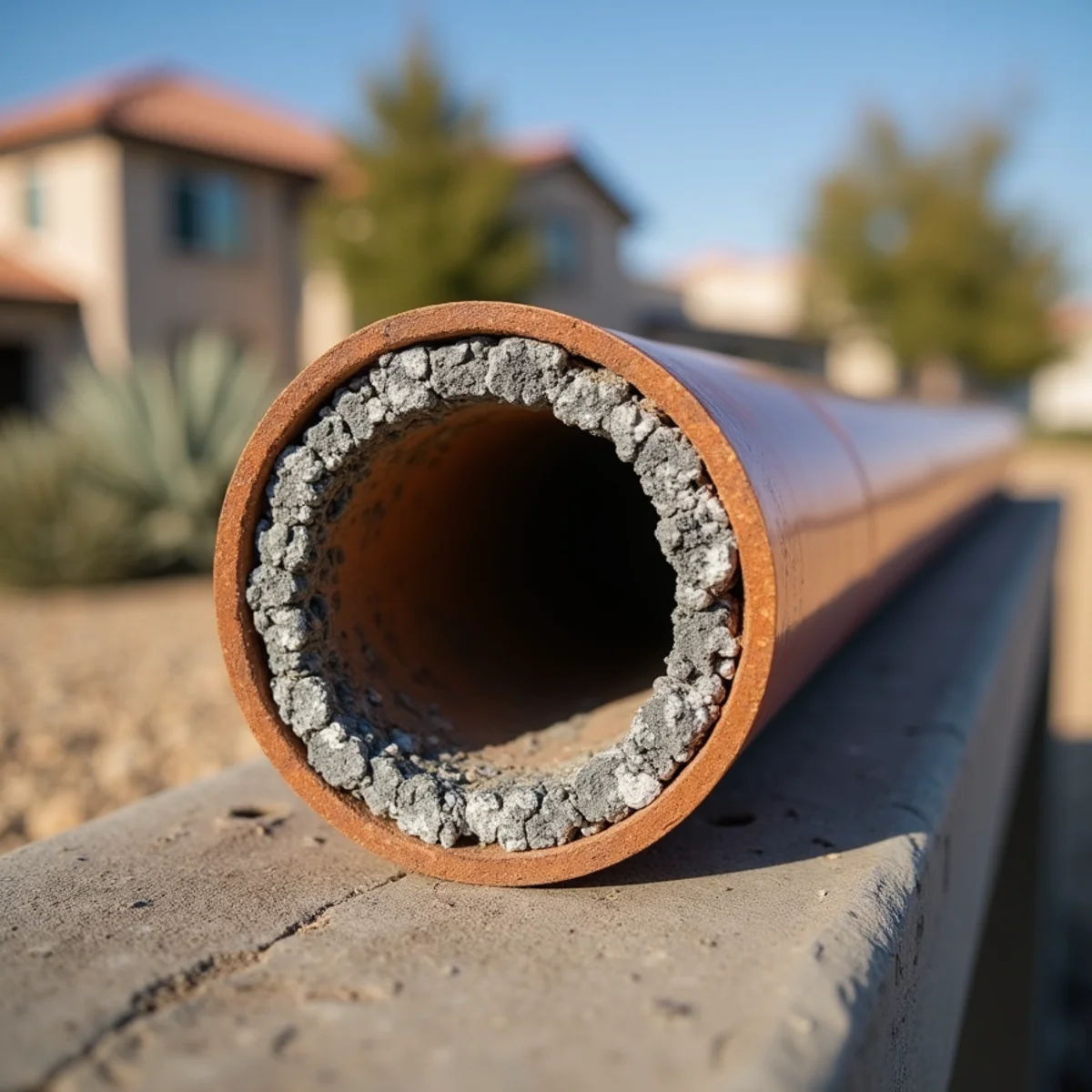
Hard water does not corrode copper directly. What it does is contribute to pitting corrosion — a localized process where deposits accumulate at a spot, disrupt the flow, and create a small area where the metal breaks down far faster than the pipe as a whole.
The result is a pinhole. The pipe around it is perfectly sound; there is just one tiny hole spraying water at line pressure. And in Menifee, most of that pipe is under a concrete slab where nobody can see it.
Copper starts pinholing at roughly twenty-five to forty years in these conditions. That timing is the entire reason slab leaks are so common in Menifee — and why they cluster by neighbourhood rather than scattering randomly.
3. Every valve, seal, and fitting
- Angle stops under sinks and toilets crust with mineral and seize. The failure mode is cruel: you discover it when you urgently need to shut water off and the valve will not turn.
- Dishwasher door gaskets develop scale that prevents proper sealing, and the leak runs under the unit into the cabinet base where you cannot see it.
- Washing machine inlet valves clog and stick, and a valve that fails open floods a laundry room at full line pressure.
- Refrigerator ice maker lines accumulate deposits at the fitting and begin to weep — slowly, behind the fridge, for months.
- Faucet aerators and shower heads clog visibly, which is annoying rather than dangerous but tells you exactly what is happening everywhere else you cannot see.
Why this hits Menifee harder than most cities
Two things compound. The first is the water chemistry described above. The second is the city's construction history.
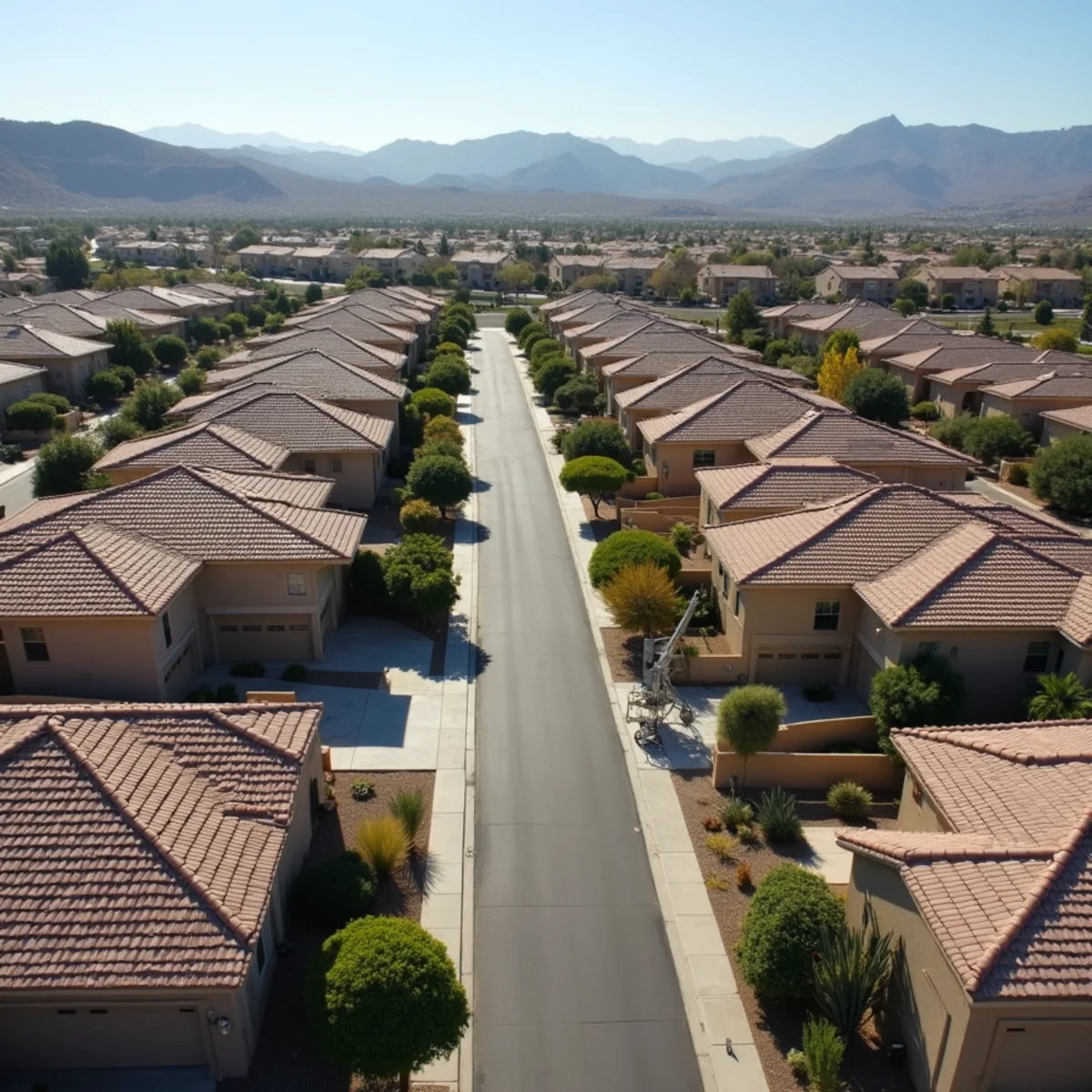
Menifee was built in waves — Quail Valley and Homeland in the 1970s and 1980s, Sun City and Menifee Lakes through the 1980s and 1990s, Heritage Lake and Paloma Valley in the 1990s and 2000s, Audie Murphy Ranch in the 2000s and 2010s. Each wave installed its plumbing in a compressed window, which means each wave reaches the end of that plumbing's service life in a compressed window too.
That is why we run so many slab leaks on the same streets in the same months. It is not coincidence and it is not bad luck — it is a schedule. We wrote about the pattern in detail in Menifee's first repair cycle.
What actually helps
Flush your water heater every year
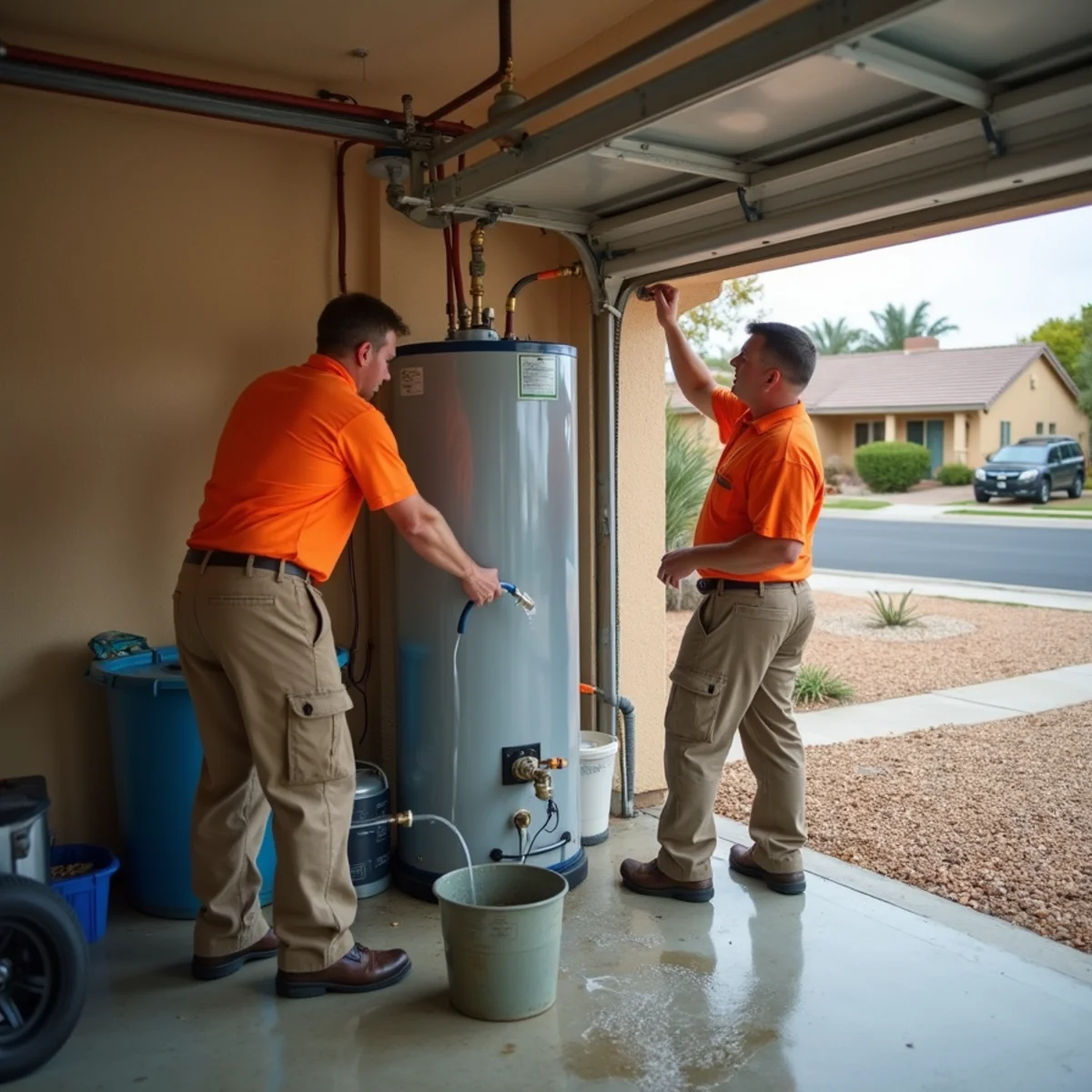
This is the highest-return maintenance task available to a Menifee homeowner, and almost nobody does it. Connect a hose to the drain valve at the base of the tank, run it to a drain or the yard, shut off the cold supply, open the drain, and let the sediment out. Full walkthrough in our guide to annual water heater maintenance in hard water.
Consider a water softener
For most Menifee homes the case is genuinely strong, and it is mostly an appliance argument rather than a comfort one. Softening reduces the scale that shortens water heater life, keeps dishwasher and washer components working, and stops angle stops seizing.
Be clear on what it does not do: it will not restore copper that is already thirty-five years old and pitting. And it adds a maintenance task of its own. It is a slow-down, not a reversal.
Replace supply hoses on a schedule, not on failure
Rubber washing machine hoses should go every five years regardless of appearance — they fail from the inside. Braided stainless lasts longer but is not permanent. Thirty dollars of hose is protecting against a claim that averages several thousand.
Exercise your shutoff valves
Once or twice a year, turn every angle stop in the house fully off and back on, and do the same at the main. It takes ten minutes and it stops mineral deposits locking them solid. A valve you cannot turn during an emergency is worse than no valve at all.
The one number worth watching
Your EMWD bill. A sudden increase with no change in household habits is the most objective early warning of a slab leak you will get, and it usually shows up long before anything is visible. If your usage jumps and nothing about your life changed, get a moisture inspection and leak detection visit before you go looking for an explanation.
Where the mineral actually ends up
Hardness is easy to picture as scale on a kettle. What it does inside a house is less obvious, because the damage happens in the places you never look at, and it happens to different components in a fairly predictable order.
| Component | What the mineral does | Typical consequence |
|---|---|---|
| Water heater tank | Scale settles on the bottom, insulating the burner from the water above it | The burner runs longer and hotter, the tank steel fatigues, and the unit fails years early |
| Angle stops and shut-off valves | Deposits build in the valve body and seize the mechanism | The valve will not turn on the night you need it — the single most common cause of a small leak becoming a large one |
| Toilet fill valves and flappers | Abrasive deposits score the sealing surfaces | A silent running toilet that adds to the bill for months before anyone notices |
| Washing machine and dishwasher inlet valves | Grit holds the solenoid valve fractionally open | A slow seep behind an appliance nobody moves, into the wall behind it |
| Aerators and shower heads | Visible white crusting, restricted flow | Cosmetic and easily fixed — but it is the visible warning that the invisible components are getting the same treatment |
The pattern worth noticing is that hard water rarely causes a dramatic burst. It causes components that were supposed to close to stop closing properly, which is why so many Menifee losses start as something small that ran for a long time.
Why the valve you never use is the one that matters
If you take one practical action from this article, make it this one. Go around the house and turn every shut-off valve you can find — under each sink, behind each toilet, at the washing machine, at the water heater — fully closed and then fully open again. Twice a year.
In this water, a valve that has not moved in eight years is frequently seized solid. The moment you discover that is almost always the moment you urgently need it to work, standing in water at two in the morning, and the alternative is finding the main at the street in the dark. A seized angle stop turns a ten-minute problem into a whole-house shutdown and, quite often, into a restoration job.
Two warnings. Turn them gently — if a valve will not move with reasonable hand pressure, stop and replace it rather than forcing it, because a snapped valve stem is a much worse evening. And check under the sink afterwards, because occasionally a valve that has not been touched in a decade will weep slightly from the packing nut once it has been exercised. That is a fifteen-minute fix discovered on your terms rather than at midnight.
Frequently asked questions
How hard is Menifee water exactly?
EMWD publishes water quality data in its annual Consumer Confidence Report, and that is the right source for specific figures rather than any contractor's claim. What is well documented is that the district operates reverse-osmosis desalination facilities — including the Menifee Desalter, in service since 2002 — specifically because the local groundwater is naturally brackish.
Will a water softener stop slab leaks?
It will likely slow the process by reducing scale that contributes to pitting. It will not save copper that is already decades into service. If your home is from the 1980s or 1990s and has had one pinhole, a softener is worth having but a reroute conversation is the more important one.
Is hard water bad for my health?
No. EMWD water meets all state and federal drinking water standards. Hard water is a plumbing and appliance problem, not a health one — the minerals involved are calcium and magnesium, which are dietary nutrients.
Will a water softener stop all of this?
It addresses the cause rather than the symptoms, so it slows scale formation in the heater, the valves and the fixtures throughout the house. What it does not do is reverse damage already done, and it introduces its own maintenance — salt, and a system that can itself leak. It is a genuine improvement in this water, but it is a system to look after rather than a device to forget about.
Is the water actually unsafe, or just hard?
Hardness is a mineral content issue, not a safety issue — it is about what the water does to plumbing and appliances rather than to people. Questions about drinking water quality belong with Eastern Municipal Water District, who publish annual water quality reports for the areas they serve. This article is strictly about what the mineral load does to the inside of your house.